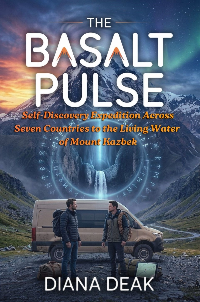

Discover The Voice of Monte Perdido, Book 3 in The Basalt Pulse

The Basalt Pulse · Volume III
The Voice of Monte Perdido
A mountain that has been waiting. An instrument built by hands that can no longer answer questions. And a frequency that finally, after two volumes, says a name. This is the complete guide to Book 3 of The Basalt Pulse - the story, the real mountain behind it, every chapter, and where to start reading tonight.
Read it now on Amazon → Explore the guide ↓In this guide
- A note from the author
- The dedication
- From the preface
- The story so far: Volumes I & II
- What Volume III is about
- Full chapter-by-chapter guide
- Monte Perdido: the real mountain
- The science behind the fiction
- The themes beneath the frequency
- Meet SAM, Albert, and Marcos
- Who this book is for
- The journey, stop by stop
- Three volumes, three real mountains
- Read an excerpt
- The sensory mood board
- Book club discussion questions
- How to read this book
- About Diana Deak
- More books by Diana Deak
- What readers are saying
- A short glossary for new readers
- Where to buy
- Frequently asked questions
A note from Diana, before you begin
Every book in this series has started the same way: with a real mountain that would not leave me alone until I understood what it wanted to say. Volume I was a dream and a device. Volume II was Kazbek, and the living water at its foot. Neither of those books felt, while I was writing them, like they were building toward anything in particular - they each felt complete on their own terms.
The Voice of Monte Perdido is the book I did not plan to write. It arrived the way the third mountain always arrives in a journey like this one: quietly, insistently, with the growing sense that the road that felt, from the inside, like a series of separate choices had actually been a single path all along.
I will not tell you here what the mountain says to SAM. Summaries do to transmission what summaries always do - they preserve the content and remove the frequency, and the frequency is the entire point of this book. What I will tell you is this: the mountain was right. About everything. And SAM's grandfather - who knew things about mountains he could never fully explain, who built an instrument for exactly this purpose and pressed it into his grandson's hands with a single sentence - he was right too.
Take it further, and you will not regret it. Neither, I hope, will you.
- Diana Deak
The dedication
who built the instrument,
knew the frequency,
and trusted his grandson to find the mountain.
And for Albert.
Every frequency needs a second receiver.
For everyone who has stood at the foot of something enormous
and felt it already knew their name. The Voice of Monte Perdido, dedication page
Three short dedications, three different kinds of trust: the trust a grandfather places in a grandson he won't live to see finish the journey, the trust between two friends who let a signal go unspoken until it's ready, and the trust every reader is quietly invited into - the sense of having stood somewhere enormous and felt recognized by it.
From the preface: "On what the third mountain teaches"
The first mountain teaches you to hear. The second mountain teaches you that what you heard was not the whole of what the mountain had to say - that the first listening was an introduction, that the frequency goes deeper than the initial contact suggested, and that the only way to find out how deep is to go back.
The third mountain teaches you something neither of the others could teach: that you were always going to be here. That the journey that feels, from inside it, like a series of choices and coincidences and a Tuesday morning when a radio program happened to mention a specific peak in the Spanish Pyrenees - that journey was not accidental. The mountain had been waiting. It knew your name before you knew its.
Volume I began with a dream and a device and a mountain in Italy. Volume II took SAM and Albert to the Caucasus, to Kazbek, to the living water at the mountain's foot. Both of those books were about going toward something. This book is different. This book is about what happens after you have arrived.
The Pyrenees have been a border and a crossing for longer than most European nations have existed. Pilgrims walked through their passes. Armies broke against their winter faces. And Monte Perdido - the Lost Mountain - stood through all of it, hidden in its geological fold, showing itself only to those who came close enough, prepared enough, to deserve to see it.
SAM goes close enough.
The story so far: Volumes I & II
Before Monte Perdido ever entered the picture, The Basalt Pulse began somewhere much smaller: a dream, a strange handmade device, and a mountain near Lyon that refused to stay in the background of an ordinary life. Volume I introduced SAM as a man whose training-hall discipline and quiet attentiveness made him, without either of them planning it, exactly the kind of person a mountain might choose to speak to first. It ended with a frequency received but not yet understood - the introduction, not the conversation.
What made Volume I resonate with readers wasn't the mystery of the device itself, but the ordinariness of the life it interrupted. SAM was not a seeker before the book began. He was a man with a training hall, a schedule, and a grandfather's bag he had never fully unpacked. The novel's quiet argument - one The Voice of Monte Perdido continues - is that the people mountains choose to speak to are rarely the ones already looking for something mystical. They're the ones who have learned, through entirely unrelated discipline, how to actually pay attention.
Volume II, The Kazbek Grid, took SAM and Albert east and up, to Mount Kazbek in the Georgian Caucasus, where the signal deepened into something closer to a relationship than a message. They found living water at the mountain's foot, learned that the first listening had barely scratched the surface of what the device - and the mountain range that built it a receiver worth speaking to - actually contained. If Volume I was the invitation, Volume II was the proof that the invitation was real, and that it went further than either man expected.
Volume II also did the quiet work of turning Albert from a supporting character into a co-lead. By the time that book closes, "you'll be the first call" isn't a throwaway line of dialogue - it's a promise the reader has watched SAM earn the right to make, and one Volume III holds him to almost immediately.
Both books were, in the author's own words, about going toward something. Volume III is about what happens after you have arrived - which, as any reader of the series already senses, is rarely the end of a journey. It's the beginning of a different one.
What The Voice of Monte Perdido is about
The novel opens with a pause - a full half-year of digestion after the mountains of Volume II, because some experiences are too large to be absorbed on any faster schedule. SAM returns to his training hall and his students. Albert returns to football evenings and the careful calendar of a man who values his days. Nothing dramatic happens. And that quiet is exactly the point: the book trusts its readers enough to let the ordinary world breathe before it lets the extraordinary back in.
Act One: The Signal Returns
In December, the grandfather's device - dormant since autumn - wakes up in SAM's hands with a slow, continuous oscillation. Not urgency. Intention. What follows is a deliberate, almost meditative unfolding: a radio program that mentions one specific peak in the Spanish Pyrenees, a half-remembered bag in a storage room, and the quiet discipline SAM has learned - the hard way - about which certainties survive being spoken aloud too soon.
He thought: It knows where it's going. He thought, and so, eventually, will I. Chapter 2 · The Dream of the Mountain Near Lyon
Act Two: The Long Wait and the Climb
Six weeks between decision and departure sound, on a calendar, perfectly reasonable. Living inside them - certain of the destination, unable to act on that certainty yet - is its own particular kind of difficult, and the novel spends real, patient attention on that waiting rather than rushing past it. Then: a 6:00 AM departure, two days into the mountains, and a Wednesday when the device is finally activated at altitude, with a local guide named Marcos who has felt this mountain's attention before, though never with an instrument that could confirm it.
This is also where the novel does some of its most patient character work. Albert is not simply along for the trip; he is, by this point in the series, someone SAM has learned to trust with waiting itself - with the strange discipline of being certain and unable to act, together, without either man needing to fill the silence.
Act Three: The Chamber
Inside a basalt chamber that has waited, by the book's own account, considerably longer than SAM has been alive, fifteen minutes of silence becomes a different unit of measurement entirely. What the mountain says - and it does, eventually, say something - is the heart of the book, and true to the preface's own promise, it is not something a marketing page should summarise. Summaries do to transmission what summaries always do: they preserve the content and remove the frequency.
The mountain was not absent. The mountain was preparing. Chapter 11 · Hello
What happens next belongs entirely to the book. What can be said here is that Marcos - a guide who has spent years feeling this mountain's attention without ever having an instrument to confirm it - is standing in that chamber too, and watching his reaction is almost as affecting as watching SAM's.
Act Four: Coming Home Changed
The final third of the novel is where The Basalt Pulse distinguishes itself from a simpler adventure story. Descending the mountain is not the end of the transmission - carrying it back into a training hall, a friendship, and an ordinary Tuesday calendar is where the real inheritance gets tested. By the time the device is quietly measuring SAM's own proximity in the novel's final chapter, the reader understands that the frequency was never only about the mountain. It was about becoming someone capable of receiving it.
Full chapter-by-chapter guide (spoiler-light)
Twenty chapters carry SAM, Albert, and the grandfather's instrument from a café table in Lyon to a limestone chamber inside a UNESCO-protected mountain and back again. Here's the map, chapter by chapter, without giving away what the mountain actually says.
- 1
The Half-Year Pause
- 2
The Dream of the Mountain Near Lyon
- 3
The Radio Signal
- 4
Documenting Like a Traveler
- 5
The Grandfather's Bag
- 6
Calling Albert
- 7
The Long Wait
- 8
Departure: 6:00 AM
- 9
The Second Day: Into the Mountains
- 10
Wednesday: The Device Is Activated
- 11
Hello
- 12
The Grandfather's Real Inheritance
- 13
Three Days of Beauty
- 14
The Last Morning on the Mountain
- 15
Carrying the Memory
- 16
Back to the Training Hall
- 17
Albert's Question
- 18
What It Means to Be Recharged
- 19
The Same Feeling Again
- 20
Carry It Forward
In-depth chapter summaries
For readers who want more than a one-line teaser before diving in, here's a closer look at each chapter's territory - still without giving away the mountain's own words.
Chapters 1-5: The Signal Returns
Chapter 1, The Half-Year Pause, opens on a deliberately quiet note. SAM and Albert have returned from the Caucasus and chosen, without discussing it directly, to let the experience settle before naming it again. Their October café conversation - "I've been thinking about the device," "So have I" - is the whole chapter's tension in miniature: two men circling something enormous with total patience.
Chapter 2, The Dream of the Mountain Near Lyon, breaks that quiet. A dream arrives unannounced and total, the way dreams do for SAM specifically - not gradually, but as a complete world he's suddenly standing inside. It's the first sign that December's stillness is about to end.
Chapter 3, The Radio Signal, follows the week after the dream, as SAM tries to carry a private certainty through an entirely ordinary week of training sessions and coffee cups, while a specific name from a radio program keeps surfacing under everything else he's doing.
Chapter 4, Documenting Like a Traveler, shows SAM beginning a habit that will matter later: writing down what's happening to him, not for anyone else, but because some experiences need a witness even when no one else is present to provide one.
Chapter 5, The Grandfather's Bag, takes SAM back to a specific shelf in a storage room, and back into the old canvas bag he has not fully unpacked since it was pressed into his hands. The chapter is quiet, physical, and specific - the patina on brass buckles, the exact grey-green of old canvas - grounding the supernatural in objects you could hold in your own hands.
Chapters 6-10: The Long Wait and the Climb
Chapter 6, Calling Albert, is the chapter where a promise made at the end of Volume II finally gets kept. Saying "you'll be the first call" out loud, years after making it, changes what the words mean for both men.
Chapter 7, The Long Wait, spends six weeks - the gap between decision and departure - proving that certainty without action is its own specific kind of difficult. The mountain isn't waiting for SAM to decide anything. It's waiting for him to arrive.
Chapter 8, Departure: 6:00 AM, is short, physical, and full of the particular relief of a wait finally ending. Chapter 9, The Second Day: Into the Mountains, lets the Pyrenees themselves take over the pacing, as altitude becomes a physical fact rather than an idea.
Chapter 10, Wednesday: The Device Is Activated, introduces Marcos, the local guide, and gives the novel one of its most quietly moving beats: a man who has felt this mountain's attention for years finally watching an instrument confirm what he already knew.
Chapters 11-15: The Chamber and Its Aftermath
Chapter 11, Hello, is the chapter this entire series has been building toward. Fifteen minutes of silence inside a basalt chamber becomes, in the book's own careful accounting, a different unit of measurement entirely - and then the silence changes into something else. This is the chapter the marketing copy on this page will not summarize further.
Chapter 12, The Grandfather's Real Inheritance, follows immediately after, as SAM and Albert sit against the mountain's outer wall, the Ordesa canyon opening below them, and SAM finally understands what his grandfather actually left him - and it isn't the device.
Chapter 13, Three Days of Beauty, is a deliberate change of pace: the Ordesa Valley, the Cascade of the White Horse, and time that refuses to be rushed, giving both the characters and the reader room to breathe after the chamber's intensity.
Chapter 14, The Last Morning on the Mountain, and Chapter 15, Carrying the Memory, handle the specific grief of a good thing ending on schedule, and the honest difficulty of trying to hold an experience too large for ordinary hands as the descent begins.
Chapters 16-20: Coming Home Changed
Chapter 16, Back to the Training Hall, returns SAM to students and routines that look, from the outside, completely unremarkable - while everything underneath has quietly shifted. Chapter 17, Albert's Question, is the moment a true friend asks the one question he's waited to be sure SAM is ready to answer honestly.
Chapter 18, What It Means to Be Recharged, draws a precise line between rest and transformation. Chapter 19, The Same Feeling Again, offers proof that Monte Perdido wasn't a single, unrepeatable event - hinting at how much larger this world might still become.
Chapter 20, Carry It Forward, closes the volume on a quietly perfect note: during a routine monthly cleaning, the device measures SAM's own proximity for the first time, on its own, without calibration. His grandfather's voice returns to him with a sentence that has been true the entire time: the mountains never forget.
Monte Perdido is not invented. It is real.
One quiet pleasure of The Basalt Pulse series: the mountains are never a backdrop invented for the story. The story is built around what is actually there - and Monte Perdido, the Lost Mountain, gives the novel an unusual amount to work with.
The Ordesa y Monte Perdido National Park
Monte Perdido sits at the heart of a national park protected specifically for its geological and natural significance, designated a UNESCO World Heritage Site. Entry requires timed permits and an entrance fee, put in place to protect a fragile high-altitude ecosystem that has survived, largely undisturbed, for far longer than any human institution watching over it.
The Marbore Glacier
The Marbore Glacier is one of the most closely studied glaciers in Europe, retreating a little further every year. It's also where the novel's most striking real-world image comes from: pale, almost luminous limestone, untouched by open air for ten thousand years, emerging from beneath the retreating ice right now, as it has been throughout the years this book was being written.
The Cascade of the White Horse
At the head of the Ordesa Valley, the Cascade of the White Horse - Cola de Caballo - still falls exactly as it has for centuries. It's one of the most photographed features of the park, and one of the quieter, more reflective settings the novel returns to during its "Three Days of Beauty."
The Pic du Midi Observatory
On the French side, at 2,877 meters, the Pic du Midi de Bigorre has housed a working astronomical observatory since 1878 - a detail the novel uses to underline one of its quieter arguments: that this landscape has always attracted people willing to build careful instruments in order to listen to something larger than themselves.
The basalt, the chamber, and the frequency
The basalt columns exist. The chamber exists. What the frequency beneath the stone actually is - that, as the book's own preface insists, is something every reader has to decide for themselves.
A border that has always been a crossing
Long before this novel, the Pyrenees had already spent centuries as both a border and a crossing. Pilgrims walked through their passes on the way to Santiago de Compostela. Armies broke against their winter faces. Monte Perdido stood through all of it, tucked into its own geological fold, showing itself only to those who came close enough - and prepared enough - to deserve to see it. That sense of a landscape that has been quietly watching human history pass beneath it is one of the reasons the novel treats the mountain less like a setting and more like a character in its own right.
Why "The Lost Mountain"?
Monte Perdido translates directly as "the Lost Mountain" - a name that long predates this novel, but one that fits its themes almost too well. A peak that hides in its own fold of geology, revealing itself only to those who earn the view, is exactly the kind of place a series about listening, patience, and inheritance would eventually have to visit.
The science behind the fiction
Diana Deak holds a Master's degree in Didactic Chemistry, and that background shows up in how carefully The Basalt Pulse series grounds its more mysterious moments in real physical principles - even when the story ultimately leaves room for the reader to decide how far the mystery extends.
Piezoelectricity in volcanic rock
Basalt, like many crystalline volcanic rocks, contains minerals capable of generating a small electrical charge under mechanical stress - a real property called piezoelectricity. The novel's fictional device leans on this genuine phenomenon: pressure, temperature shifts, and the slow tectonic tension inside a mountain range can, in principle, generate detectable electrical signals from certain rock formations. The book takes that established science and asks a purely fictional question - what if an instrument could tune into it the way a radio tunes into a broadcast?
Bioelectromagnetism and the body's own signal
The human body runs on electrical signals - nerve impulses, the heart's own electrical rhythm, the subtle currents researchers can measure with an EEG or an ECG. The Voice of Monte Perdido uses this real biological fact as the other half of its central metaphor: if the mountain can produce a signal, and the body already runs on signals of its own, what does it mean for the two to be "in frequency" with each other? The novel never overstates the science - it uses it as a doorway into questions about attention, presence, and what it means to actually listen.
Real geology, real glaciology
The retreating Marbore Glacier, the newly exposed limestone, the basalt columns - none of these are invented for dramatic effect. They're genuine features of the Ordesa y Monte Perdido massif, and the novel's descriptions of them are written to be accurate enough that a reader could, in principle, go stand in the same spot the characters do.
The themes beneath the frequency
Readers drawn to eco-psychology, somatic experience, and spirituality grounded in real science and geography tend to find more in this series than a mountain-adventure plot. A few threads worth watching for:
Attention as a discipline, not a mood
SAM's ability to hear the mountain is never framed as a special gift dropped on him from nowhere. It's the result of the same discipline he brings to his training hall - the kind of attention that has to be built, practiced, and protected from being spoken about too soon.
Inheritance that outlives the person who gave it
The grandfather never appears on the page in the present tense, and yet he's arguably the book's most active character. What he built, what he knew, and what he trusted his grandson to eventually understand without being told directly, is the emotional engine of the entire volume.
Friendship measured in patience, not declarations
Albert never demands to be let into SAM's experience. He asks, waits, and trusts - and the novel treats that restraint as its own kind of intimacy.
The mountain as a living, remembering thing
The mountains never forget - a sentence the grandfather says once, early, that the entire book quietly spends two hundred pages proving true.
Grief that never uses the word "grief"
The grandfather is gone before the story begins, and the novel never asks the reader to sit through a funeral or a eulogy. Instead, grief shows up sideways - in a bag not opened for years, in a device cleaned once a month with the same cloth, in a single remembered sentence carried like a compass. It's a gentler, more sustainable way of writing loss than most adventure fiction attempts.
Digestion as its own kind of action
The half-year pause that opens the book isn't filler - it's the novel's argument that processing an experience is itself a form of doing something, not a delay before the "real" story starts. Readers drawn to somatic and nervous-system-aware storytelling tend to notice this immediately.
Conservation and earned access
The real permits and entrance fees required to enter Ordesa y Monte Perdido National Park echo one of the novel's quieter themes: that the most meaningful places don't reveal themselves to everyone equally, and that earning access - through preparation, patience, and respect - is part of what makes the arrival mean something.
Meet SAM, Albert, and Marcos
SAM
Receiver of the frequency
A training-hall discipline built over years turns out to be exactly the preparation a mountain needs from the person it chooses to speak to. SAM's defining quality isn't confidence - it's patience with certainty he can't yet act on.
Albert
The second receiver
"Every frequency needs a second receiver," the dedication says - and Albert earns that line one quiet café conversation at a time. He doesn't need to understand the device to be trusted with what it means.
Marcos
The local guide
Marcos has felt what the chamber holds for years, without ever having an instrument to confirm it. Watching him witness the device do exactly that is one of the novel's quieter, more moving turns.
SAM looked at him. "So have I."
"Is it doing anything?"
"Not yet. But I think it will."
"When it does," Albert said, "tell me."
"You'll be the first call." The Basalt Pulse, Volume III
Who this book is for
Not every reader wants the same thing from a mountain novel. Here's a quick, honest guide to who tends to love The Voice of Monte Perdido most.
You'll love this if you're drawn to real places in fiction
If you enjoy knowing that the glacier, the peak, and the observatory in your novel are places you could actually visit, this book was written with you in mind.
You'll love this if you practice mindfulness or somatic work
The novel treats attention, patience, and bodily presence as skills worth dramatizing - not abstractions to gesture at once and move past.
You'll love this if you value quiet, earned friendships in fiction
SAM and Albert never have a shouting match, a betrayal, or a forced misunderstanding for the sake of plot. Their bond is built entirely from trust, patience, and showing up.
You might want to wait if you prefer fast-paced plot twists
This is an honest note, not a warning: the novel rewards slow reading. If you want constant external action, Volume III's patient pacing may ask more of you than a thriller would.
The journey, stop by stop
For readers who like to trace a story on an actual map, here's the route the novel follows, in order.
- 1
Lyon, France
- 2
The road south
- 3
Ordesa y Monte Perdido National Park
- 4
Back to Lyon
Three volumes, three real mountains
Each book in The Basalt Pulse series is anchored to an actual range, and each one gives the frequency a different personality.
Volume I - the Alps, near Lyon
The introduction
Where the dream and the device first arrive - a signal received, not yet understood.
Volume II - Mount Kazbek, the Georgian Caucasus
The deepening
Where the signal becomes a relationship, and the living water at the mountain's foot proves the invitation was real.
Volume III - Monte Perdido, the Spanish Pyrenees
The arrival
Where the frequency finally speaks - and where SAM learns that arriving was never the end of the road.
Read an excerpt
From Chapter 7, "The Long Wait" - the six weeks between certainty and departure:
The mountain was not waiting for him to decide. It was waiting for him to arrive. Chapter 7 · The Long Wait
From Chapter 20, "Carry It Forward" - the novel's closing turn:
It was measuring him. Chapter 20 · Carry It Forward
A line from more chapters
For readers who like to collect favorite lines before they even open a book, here's one from several more chapters along the way.
Take it further, and you will not regret it. Chapter 5 · The Grandfather's Bag
The sensory mood board
If you like to set a mood before you start a new book, here's what each act of The Voice of Monte Perdido feels like, sounds like, and looks like.
The Signal Returns
Cold apartment windows. A radiator ticking in an otherwise silent room. The low hum of a device that has decided, without ceremony, that it's time. Colors: charcoal, low lamp-gold, the deep blue of a December evening.
The Long Wait and the Climb
Café conversation and comfortable silence. Packed bags by a 6:00 AM door. Thin mountain air arriving in the lungs for the first time. Colors: pale dawn grey shifting into the sharp green and stone of the trail.
The Chamber
Absolute stillness. Cold limestone under bare palms. A single column of July light tracking slowly across a chamber floor. Colors: deep basalt black, luminous pale limestone, a single shaft of gold.
Coming Home Changed
A training hall filling again with ordinary noise. A friend's question asked at exactly the right moment. Colors: warm amber, the return of everyday light after altitude.
Book club discussion questions
Reading The Voice of Monte Perdido with a group, a class, or just your own journal? These questions are designed to open conversation without asking you to give away the mountain's actual message.
- SAM waits a full week before telling Albert the device has woken up. Do you agree with his instinct that some knowledge needs time alone in the body first? When have you done the same?
- The dedication calls Albert "a second receiver." What does it mean to be someone's second receiver, in a friendship or in your own life?
- Marcos has felt the mountain's presence for years without an instrument to confirm it. Does the device change what he already knew - or only confirm it?
- "The mountain was not waiting for him to decide. It was waiting for him to arrive." How does this distinction between deciding and arriving show up elsewhere in the novel - or in your own life?
- The grandfather never appears in the present-tense story, yet shapes nearly every chapter. How does the novel keep an absent character so present?
- Chapter 18 is titled "What It Means to Be Recharged" rather than "What It Means to Rest." What distinction is the novel making?
- By the final chapter, the device is measuring SAM himself. What do you think this means for where the series goes next?
- How does the novel's grounding in real geography - an actual UNESCO mountain, an actual retreating glacier - change how you read its more mysterious elements?
How to read this book
A few notes for getting the most out of The Voice of Monte Perdido, whether it's your first mountain in this series or your third.
Read Volumes I and II first, if you can
This book pays off promises made across two earlier volumes. It's designed to work as a standalone story too, but the emotional weight of "you'll be the first call" lands hardest if you were there when SAM made it.
Keep the pace the book asks for
This is not a fast-adventure page-turner. The novel deliberately slows down around waiting, silence, and digestion - the half-year pause, the six-week wait, the fifteen minutes inside the chamber. Reading it in longer, quieter sittings rather than rushed fragments tends to serve it better.
Paperback or Kindle?
Either works beautifully. Readers who like to underline the grandfather's lines - and there are several worth underlining - often prefer paperback for this one. Kindle readers can use the built-in highlight feature to build their own personal collection of frequency quotes.
About Diana Deak
Continue the series
(Replace the # links above with your existing Blogger posts for Volume I and Volume II to build internal links between the series.)
More books by Diana Deak
If mountains and frequency aren't the only thing that drew you here, Diana's catalog spans mindfulness, literary fiction, and self-help - all built with the same care for real research behind a gentle, practical voice.
Mindfulness
The Clarity of My Mindfulness
Mindfulness
The 5-Minute Reset
Literary Fiction
The Conscious Choice
Literary Fiction
Beyond the Veil
(Swap in your own book links and covers here - this is a good spot for cross-promotion once this post is live.)
Companion journals for the series
If you've journaled alongside Volumes I and II, a Monte Perdido companion journal is a natural next addition to the self-discovery shelf this series has quietly built - a place for readers to sit with their own frequency, their own inheritances, and their own mountains, real or otherwise.
(Link your existing Basalt Pulse journals here, or note that a Volume III companion journal is coming soon.)
What readers are saying
Placeholder cards below - swap in your real reader reviews from Amazon or Goodreads once they arrive.
"Add a short reader quote here, with their first name and where they left the review."
"Add a second reader quote here - two or three sentences is plenty."
A short glossary for new readers
A few terms that come up often when readers and reviewers describe this series - useful if you're new to the genre space it lives in.
Eco-psychology fiction
Fiction that explores the psychological and emotional relationship between people and the natural world - not nature as backdrop, but nature as something that shapes, challenges, and sometimes heals the people in the story.
Frequency novel
An informal term readers have used for this series: a story built around the idea of tuning into something - a place, a person, a memory - the way you'd tune a radio, with attention and patience rather than force.
Somatic literary fiction
Fiction attentive to the body's experience - weight, breath, temperature, the felt sense of a place - rather than only the events of the plot. The Voice of Monte Perdido leans heavily on this approach in its chamber scenes.
Where to buy The Voice of Monte Perdido
The novel is available on Amazon in the formats below. Tap any link to go straight to the listing.
(Update the middle labels above once you confirm which formats/programs each edition is enrolled in.)
Frequently asked questions
Do I need to read Volume I and Volume II first?
You'll get more out of The Voice of Monte Perdido if you've read The Basalt Pulse and The Kazbek Grid first, since Volume III pays off promises made in both. That said, the novel is written to stand on its own for new readers.
Is Monte Perdido a real mountain?
Yes. Monte Perdido stands at 3,355 meters in the Spanish Pyrenees and is part of the Ordesa y Monte Perdido National Park, a UNESCO World Heritage Site. The glacier, the cascade, and the observatory described in the novel are all real.
What genre is The Basalt Pulse series?
It's literary fiction with a strong thread of spirituality, eco-psychology, and adventure - grounded in real geography and science rather than invented fantasy rules.
Where can I buy The Voice of Monte Perdido?
The book is available on Amazon - tap any "Read it now on Amazon" link on this page to go straight to the listing.
Who are SAM and Albert?
SAM is the series' central character, the one the mountains speak to. Albert is his closest friend, described in the dedication as the frequency's "second receiver" - the one SAM trusts enough to call first.
Is there a fourth volume planned?
The series is designed as an ongoing journey through real mountain ranges, so keep an eye on this blog and Diana Deak's Amazon author page for future volumes.
Is this a spiritual book, a science book, or fiction?
All three, gently. It's literary fiction that treats real science - piezoelectricity, bioelectromagnetism, glaciology - as a doorway into spiritual and eco-psychological questions, without ever losing its grounding in an actual place.
How long is The Voice of Monte Perdido?
The novel runs twenty chapters, following SAM and Albert from a Lyon café table through the Spanish Pyrenees and back home again.
Is this book appropriate for readers new to literary fiction?
Yes. The prose is accessible and dialogue-driven, and the pacing rewards patient reading rather than prior familiarity with literary fiction as a genre.
(Embed your Blogger or email-list signup form here.)
Start reading The Voice of Monte Perdido today
Twenty chapters. One real mountain. A frequency that has been waiting since Volume I to finally say something.
Get the book on Amazon →Have you read Volume I or Volume II of The Basalt Pulse? Tell me in the comments which mountain spoke to you first. 🏔️


Comments
Post a Comment