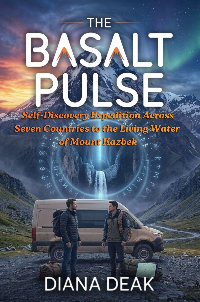

The Basalt Pulse Volume IV: Behind Atlas of Grammos


Behind the Story · The Basalt Pulse · Volume IV
He Knew About the Burning Before I Told Anyone
A stranger's phone call at 14:32. A mountain that kept a war's secret for decades. And the device that finally let someone listen.
Read Atlas of Grammos →The call at 14:32
It was a Tuesday — the twelfth of September, in the book. SAM's phone rang from an unfamiliar number. The voice on the other end knew his name before he said it, and knew something else that made his chest go tight: a burning sensation in his palms that had started roughly three weeks earlier, which he had told exactly one person about.
That man introduced himself only as Atlas. Not his real name - one people had started calling him years ago, for reasons the book slowly makes clear.
"Short and concise, at four o'clock"
Atlas asks SAM to meet him at a small Lyon restaurant called Totem & Tempo. SAM barely gets a word out before he hears himself agree. Atlas, it turns out, is one of the more quietly respected men in the city - profound, anchored, exactly the kind of person who makes refusing feel like the wrong kind of caution.
That single sentence is what the entire book swings on. What does a stranger want with something that private - and how does he already know it?
A mountain, a grandfather, a silence
Atlas wants one thing: SAM's family device, and SAM himself, to come with him to Mount Grammos - 2,520 metres, in the Western Macedonia range, site of the final major battles of the Greek Civil War. Atlas's own grandfather fought there, came home, and never spoke of it again. Thirty years of research never let Atlas feel what that silence actually held.
SAM, understandably, is skeptical. "It's an inheritance," he tells Atlas. "That's all I'll say about it." I wanted that guardedness in the book - some things deserve exactly that answer, however compelling the offer.
The dream that moved everything forward
On the same night SAM agrees, Atlas has a dream of his own - his dead grandfather, telling him plainly not to be sorry. That the silence was never punishment. That it was a mission to evolve, just in a different way than mountains usually ask people to evolve.
They leave Lyon on the eighth of September at seven in the morning, in SAM's own car, Gloria, carrying a device that reads a steady twenty-three - a number none of them yet understand will not hold once they reach the mountain.
Past the red line
They reach Nestorio, the village at the mountain's foot, where Atlas insists on paying for everything, exactly as he promised. Inside Grammos, in a hidden chamber no official map records, the device climbs past forty - past the red line SAM had always assumed was theoretical.
What that story actually is, I'll leave for the book itself. Some things are better found exactly where they belong - underground, by lantern light, with no warning.
The long mountain, and a day beside the water
A second day takes them further - to a connected ridge the local people simply call "the long mountain," older than anything the war touched. And on the last full day, they rest beside the Tsoubas Waterfall, near the monastery of the same name - a place that asks nothing of them at all.
"To forget what happened is as if you live day by day without realizing what you are doing," Atlas tells them earlier in the book. "You are here. You must know what was." By the waterfall, for one day, none of that weight is required.
Full of energy, on the fourth day
They start back home on the fourth day - not relieved that the ordeal is over, but recharged, carrying something considerably larger than when they left. Atlas, who had come to Grammos alone four times across thirty years, leaves this time with people he finally calls friends.
I think that may be the actual ending of this story, underneath the mountain and the war and the device. Not what they found inside Grammos. Who they found it with.
The mountain that rewards return
Somewhere in the Western Macedonia range, a chamber is still waiting - and a silence, finally broken, by exactly the people who earned the right to break it.
Discover Atlas of Grammos →Have you ever carried a question, or a family silence, for far longer than you should have had to carry it alone? I'd love to hear about it in the comments. 🏔️


Comments
Post a Comment